Researchers Discover a ‘Golden Pathway’ on the Ocean Floor
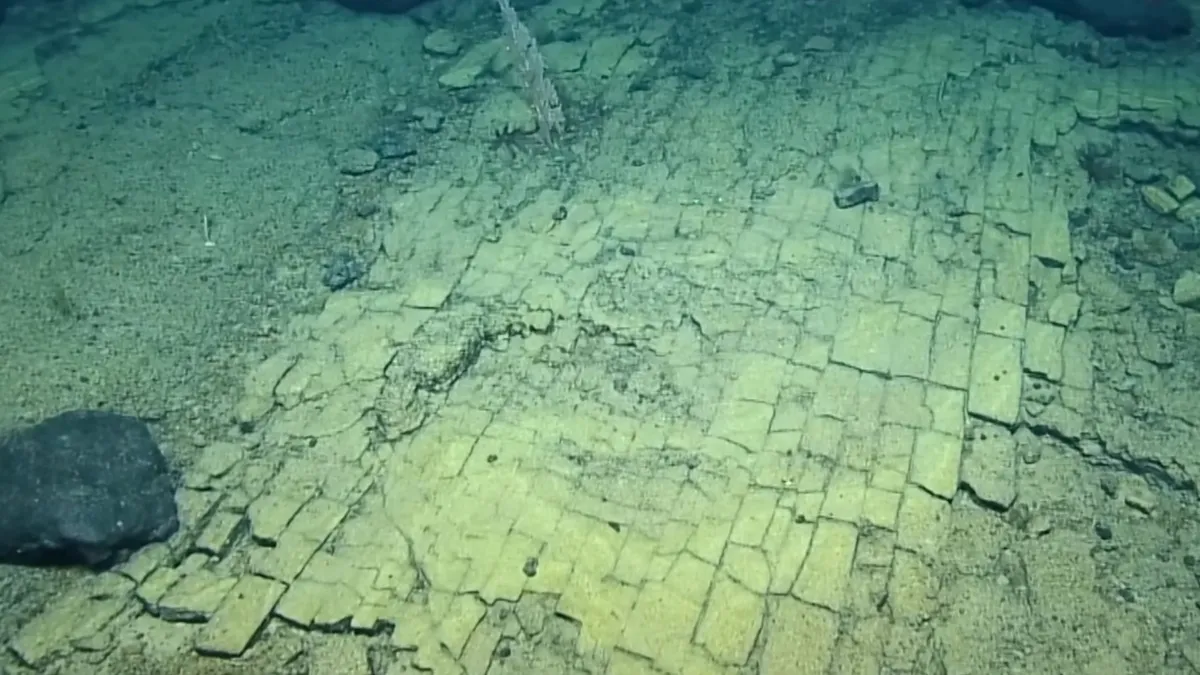
In an unexpected turn, scientists embarked on an expedition in 2022 that uncovered what looks like a “yellow brick road” on the seabed. Found on the floor of the Liliʻuokalani Ridge within the Papahānaumokuākea Marine National Monument (PMNM), the find has grabbed the attention of both researchers and the public. Working out what this formation means for Earth’s geological past could shape future research.
A closer look at the ancient formation
The PMNM, just north of the Hawaiian Islands, is known as one of the biggest marine protected areas on the planet. The site is “larger than all the national parks in the US combined” and offers a huge playground for marine exploration. On this underwater landscape, the Nootka seamount revealed a striking feature: a dried-up lakebed more than 1,000 metres deep. The surface looks like a “baked crust”, but there’s more to it than appearance.
The feature is a fractured flow of hyaloclastite rock, with unique 90-degree fractures. Hyaloclastite forms during high-energy eruptions when lots of rock fragments fall onto the seabed. Repeated heating and cooling from several volcanic eruptions created stresses that cracked the rock, producing a pattern that gives the impression of a path straight out of a storybook.
Who took part in the expedition
The mission was run by the Ocean Exploration Trust using the Nautilus (E/V Nautilus) exploration vessel. The work was supported by the Ocean Discovery League, Scripps Institution of Oceanography, and Boston University. People on board were clearly shaken by the sight, shouting lines like “It’s the road to Atlantis” and “The yellow brick road?”—moments that made it into a YouTube clip.
Footage released in April 2022 gives the public a rare look at this deep-sea scene, sitting over 3,000 metres (approximately 9,843 ft) below the surface. As the deep-sea vehicle moved along the feature, the team pointed out that only about 3% of the PMNM seafloor has been explored, a reminder of how little we’ve actually seen.
What the find could tell us
This discovery on the Liliʻuokalani Ridge is more than just a neat visual; it could open the door to new knowledge about Earth’s buried geology. The Ocean Exploration Trust says that surveying “never-before-surveyed areas” lets scientists probe life and processes on the rocky flanks of these old seamounts. A 2025 study even estimated that only between 0.0006% and 0.001% of the deep seafloor has been visualised, which underlines how much remains unknown.
Metaphorically following a yellow brick road, researchers feel they are “headed in the right direction”. The data gathered could deepen our understanding of undersea geological formations and add real weight to marine conservation efforts worldwide.
The route taken by explorers aboard the Nautilus in 2022 serves as a reminder of the mysteries held in the ocean’s depths and of the technology that lets us find them. As attention on these places grows, so does the realisation of how little of the planet’s seafloor has been explored. This striking discovery invites us to push on and learn more about Earth’s hidden geological masterpieces.